Last updated October 15, 2026
How to Hire a ADU Contractor in Orange County: A Step-by-Step Guide
Orange County’s CSLB complaint database shows more ADU-related complaints filed between 2022 and 2024 than any other residential category. The contractors named in those complaints were not unlicensed. Most held active B licenses, carried liability insurance, and had websites full of polished project photos. That is the problem this guide is built around. Hiring the right ADU contractor in Orange County is not about finding someone skilled. It is about eliminating the ones who will take your deposit, slow-walk your permit, and leave you arguing about change orders eighteen months in. This guide walks through the screening process step by step.
Quick Answer
To hire an ADU contractor in Orange County, verify the license on the CSLB website, check permit history through the city’s building department, get a written fixed-price contract that names the party responsible for pulling permits, and confirm a lien waiver schedule before you pay the deposit. A contractor who refuses any of these four steps should be crossed off the list, regardless of how good the bid looks. You are not hiring a builder yet. You are screening out the ones who will not finish.
Table of Contents
- Verify the License, Then Dig Past It
- Check Permit History: What the City Knows
- The Four Contract Terms That Decide Your Recourse
- Reference Checks That Surface Real Track Records
- Red Flags in the Bid Process
- Questions to Ask About Subcontractors
- Build Methods: Prefab, Modular, or Conventional
- Common Mistakes to Avoid
Verify the License, Then Dig Past It
Everyone tells you to “check the license.” Here is what that actually means in Orange County, and what it misses. Start at the Contractors State License Board website. Search the contractor’s name or license number. You are looking for three things on the license detail page: the status, the classification, and the issue date. The status must read Active. Not inactive, not expired, not “active with conditions.” The classification matters: a B, B-2, or C-5 is what you want for an ADU. A general C-33 painting license does not authorize a residential addition.
The issue date tells you how long the principal has held a license. A license issued in 2021 for an LLC with no prior history under that qualifier means the person on the paperwork has gone through at least one corporate restructure. That does not automatically disqualify them, but it means the “20 years in business” claim on their website refers to an entity that no longer exists or a different qualifier. Confirm the qualifier’s name on the license record. Then search that name in the CSLB disciplinary actions database. A clear license status does not mean a clean history. Disciplinary actions drop off the public-facing search after ten years, but the underlying violations still say something about how the qualifier operated.
What “clear” status does not tell you:
- Whether the contractor has a pattern of abandoning permitted jobs after rough inspection
- Whether they subcontract 80% of the scope to crews with no CSLB presence at all
- Whether they have an H-6 home improvement salesperson registration violation on file
- Whether they re-keyed the corporate entity after a bond payout was triggered
The license check is the floor, not the ceiling. In Orange County, where coastal commission overlays and fire-safe regulations in canyon zones will test a contractor’s code knowledge within the first month of permitting, you want to know the qualifier has been through this specific gauntlet before.
If you are working with Fielding ADU Orange County, ask for our qualifier’s name and check the CSLB record yourself. We encourage it. The Garrison Standard has been our operating discipline since 2006, and no page on this site asks you to trust a license claim we will not let you verify.
Check Permit History: What the City Knows
Orange County is not one building department. It is 34 cities plus unincorporated county territory, and each one keeps its own permit records. Santa Ana, Anaheim, Irvine, Huntington Beach, Orange, Fullerton, Mission Viejo, and every other city runs its own system. The city knows things the CSLB database does not: how many ADU permits a contractor has pulled, whether those permits were finalized, and whether any final inspections got scheduled and then cancelled.
Here is how you run the check:
- Pick the three most recent ADU jobs the contractor claims to have completed in Orange County.
- Ask for the address of each one. If the contractor will not give you the address, that is a screening fail. Move on.
- Call or search that city’s building and safety department public records portal. Ask for the permit history on that address.
- Look for a finaled permit. Not an issued permit. A finaled one. Issued means someone pulled paper. Finaled means the city signed off on the finished structure.
We have seen this pattern repeatedly in Orange County: a contractor lists six ADU projects on their site. Five permits were issued. Two were finaled. Three show as expired or “active” for over two years, which means the work stalled and the owner either fired the contractor or ran out of money fighting stop-work orders. The city knows which one.
Building departments in coastal Orange County also track planning approvals for setbacks, height limits, and fire department review comments. A contractor who says “we handled that” should be able to tell you exactly which planner they worked with in which city. Vague answers here mean the permit experience they are selling might have happened in a different county with different rules.
The Four Contract Terms That Decide Your Recourse
Most homeowners read the price line and skim the rest. That is the wrong order. The four terms below are what determine whether you have any legal leverage when something goes wrong. Price matters, but these four decide whether the price stays what you were told.
1. Written scope of work
The scope must list every room, every system, every finish material, every fixture, and every exclusion. “ADU build, 750 sq ft” is not a scope. It is an invitation for the contractor to define “standard” at his discretion later. The scope is the contract. Ask for a line-by-line breakout and a written statement of what is not included: landscaping, temporary power, trenching past the property corner, that kind of thing.
2. Fixed price or cost-plus?
Fixed price means the number does not move unless you sign a change order. Cost-plus means you pay actual cost plus a markup, which is a blank check taped to your wallet. No legitimate reason exists for an Orange County ADU contractor to price a standard build on a cost-plus basis. Labor markets here are stable, material pricing is available, and a competent builder can hold a number for ninety days. If the price comes with a contingency on “market conditions,” that is not fixed. The Garrison Standard requires a written price before any work starts, and that is the only way we will build.
3. Who pulls the permit?
This must be in writing, on the contract, under its own heading. In Orange County, the party who pulls the permit is the party the city holds responsible for code compliance. If the contractor tells you to pull the owner-builder permit, that is a separate conversation with real legal consequences: you become the legally responsible builder, and you will be treated by the city as such. Some homeowners choose this route to save money. Your call. But if the contractor is steering you there without explaining the liability shift in writing, that is a definite screening fail.
4. Lien waiver schedule
Lien waivers are the receipts that prove your contractor paid the subs and suppliers who worked on your project. Without waivers, a subcontractor who did not get paid can file a mechanic’s lien against your property, even if you already paid the general contractor in full. Two lien waiver formats exist: unconditional and conditional. Unconditional waivers are what you want at each payment milestone. The contract should name the specific milestones, the payment amount at each one, and the waiver you receive in exchange. If the contract is silent on lien waivers, walk away. In Orange County, a property with a mechanic’s lien on it will sit unsold until the lien is cleared, and clearing one takes legal work you did not budget for.
Reference Checks That Surface Real Track Records
Every contractor can produce three references who will say nice things. That is not screening. Screening means asking questions the reference has to think about, and then checking what they say against the paper trail.
Ask for references from jobs completed at least two years ago. A job finished last month has not had time to fail. A roof leak, slab crack, or electrical fault usually shows up within the first year or two. The 365-Day Done Right Promise we attach to every build exists because workmanship defects often reveal themselves after weather cycles and thermal expansion, not at final walkthrough.
When you call, ask these five questions, in this order:
- Was the job finished within sixty days of the original completion date?
- Did the final invoice match the contract price, excluding change orders you signed?
- Did the contractor pull the permit, or did you?
- Since completion, have you had to call them back for any repair?
- Would you hire the same crew again, and would you let them in your house without you home?
Question five separates “the work was fine” from “I trust this outfit.” Listen for hesitation. A reference who pauses before answering is telling you something.
Then cross-check against city records. If the reference says the job was finaled and the permit shows as still open, one of them is wrong. The paper record is the one that matters if you end up needing recourse.
Red Flags in the Bid Process
Experienced Orange County homeowners recognize these patterns because they have seen them unfold. If you spot any of these during the bid, do not negotiate. Move on.
- Bid returned within 24 hours without a site visit. No one can price an ADU in Orange County without measuring setbacks, checking utility access, and reviewing the title’s easements. A fast bid means it is a placeholder number designed to anchor you before the change orders come.
- No site walk at all. If the contractor is willing to build without ever walking the lot, he is not going to be there during construction either.
- Price contingent on “permit outcome.” This phrase means the contractor has not done the planning review and does not want to be held to the number if the city pushes back. What really happens: the permit comes back with conditions, and suddenly the project costs $25,000 more and it is your problem.
- Deposit demand above 10% or $1,000, whichever is less. California law caps the down payment for home improvement contracts at the lesser of $1,000 or 10% of the contract price. If someone asks for 30% down to “secure materials,” they are either ignorant of the law or choosing not to follow it. Neither inspires confidence.
- Vague payment schedule. “Progress payments as work advances” is not a schedule. It is a negotiation every two weeks. The contract should spell out the exact dollar amount at each milestone: foundation, framing, rough-in, drywall, trim, final.
- Pressure to sign before the permit is approved. A legitimate Orange County ADU contractor knows the permit process here runs months. Anyone pushing you to sign and pay before the city even does its first plan check is trying to lock in a commitment before the actual scope becomes clear.
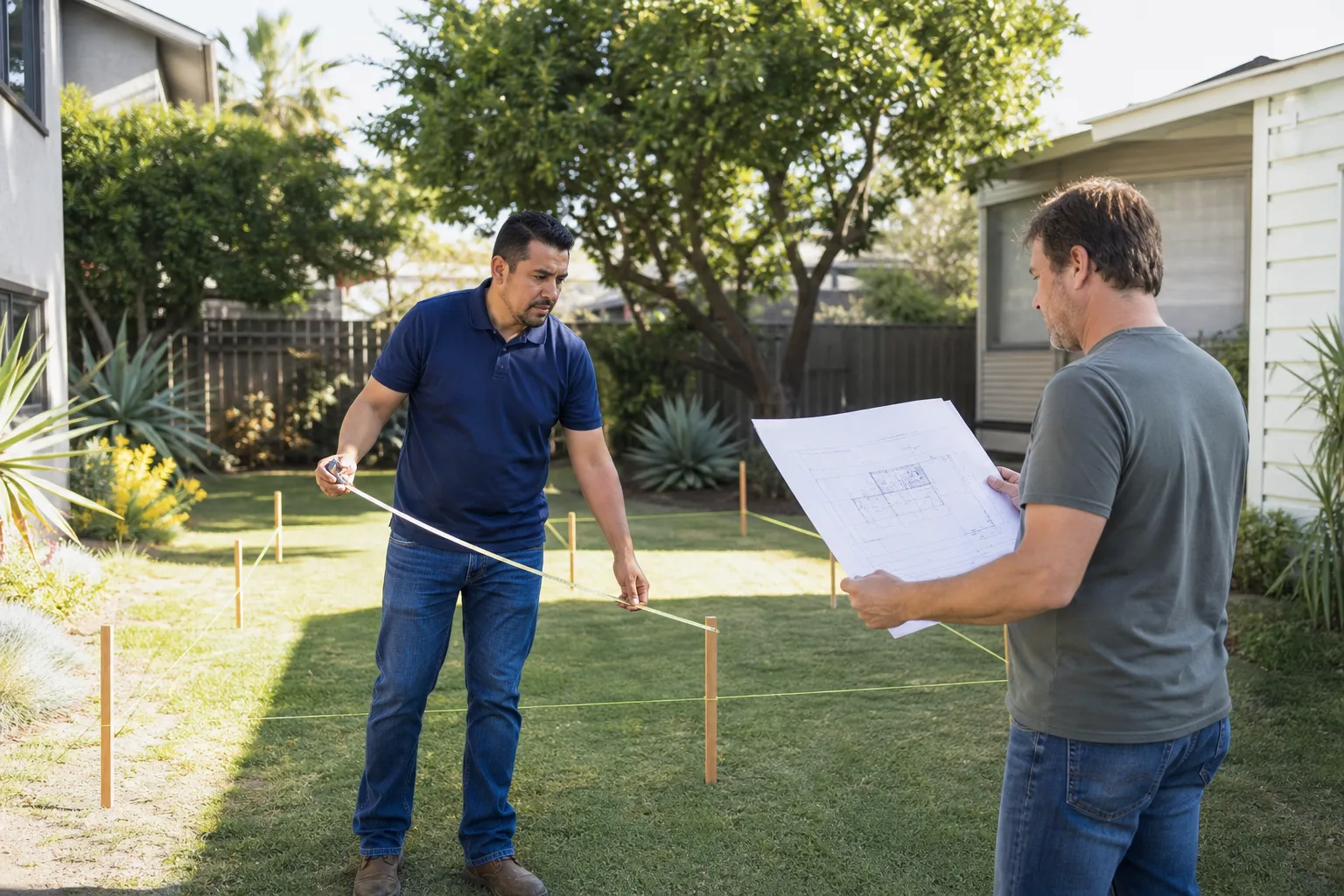
We walk every lot before we price. We have built ADUs in Orange County since 2006, and no two lots are the same, even in the same tract in Irvine or Fountain Valley. If a contractor will not stand on the dirt before quoting, he will not stand behind the work after.
Questions to Ask About Subcontractors
Most ADU contractors self-perform less than 40% of the work. The rest is subcontracted: concrete, framing, electrical, plumbing, roofing, drywall. That is normal. The question is not whether the contractor uses subs. The question is who those subs are, whether they are licensed, and who pays them.
Ask these specific questions during the bid:
- Will you provide a written list of every subcontractor who will step on my property, with their license numbers?
- What percentage of the work will your own W-2 employees perform?
- If a sub walks off the job, who is responsible for finding and paying the replacement?
- Do your subs sign lien waivers at each payment draw?
- Have any of your subs filed a lien against a previous project of yours in Orange County?
Question five is the one that tells you the most. Watch the body language. A contractor who has been through a lien fight will either tell you the story straight or get defensive. Either answer is useful.
Fielding ADU Orange County operates under the Garrison Partners family, where every crew member is background-checked and shows up in uniform. You know exactly who is on your site, and every sub carries a license we can show you before they start. That is not a marketing line. It is the operating floor.
Build Methods: Prefab, Modular, or Conventional
Orange County homeowners now have three structural paths, and the right one depends on your lot, budget, and timeline. A contractor who only knows one path is not giving you options. A contractor who knows all of them can tell you where each one fails.
Prefab and modular
Prefab platforms like Abodu, Cover, and Dvele build panels or entire modules in a factory and assemble on site. The advantage is speed and tighter quality control in a controlled environment. The tradeoff is design flexibility: you are choosing from their catalog, not drawing your own. Prefab also requires careful site coordination. A module that arrives on a truck cannot be lifted over a 15-foot utility line without a crane plan and Southern California Edison sign-off. In older Orange County neighborhoods with narrow alleys and overhead utilities, this is the thing that catches people.
Conventional construction
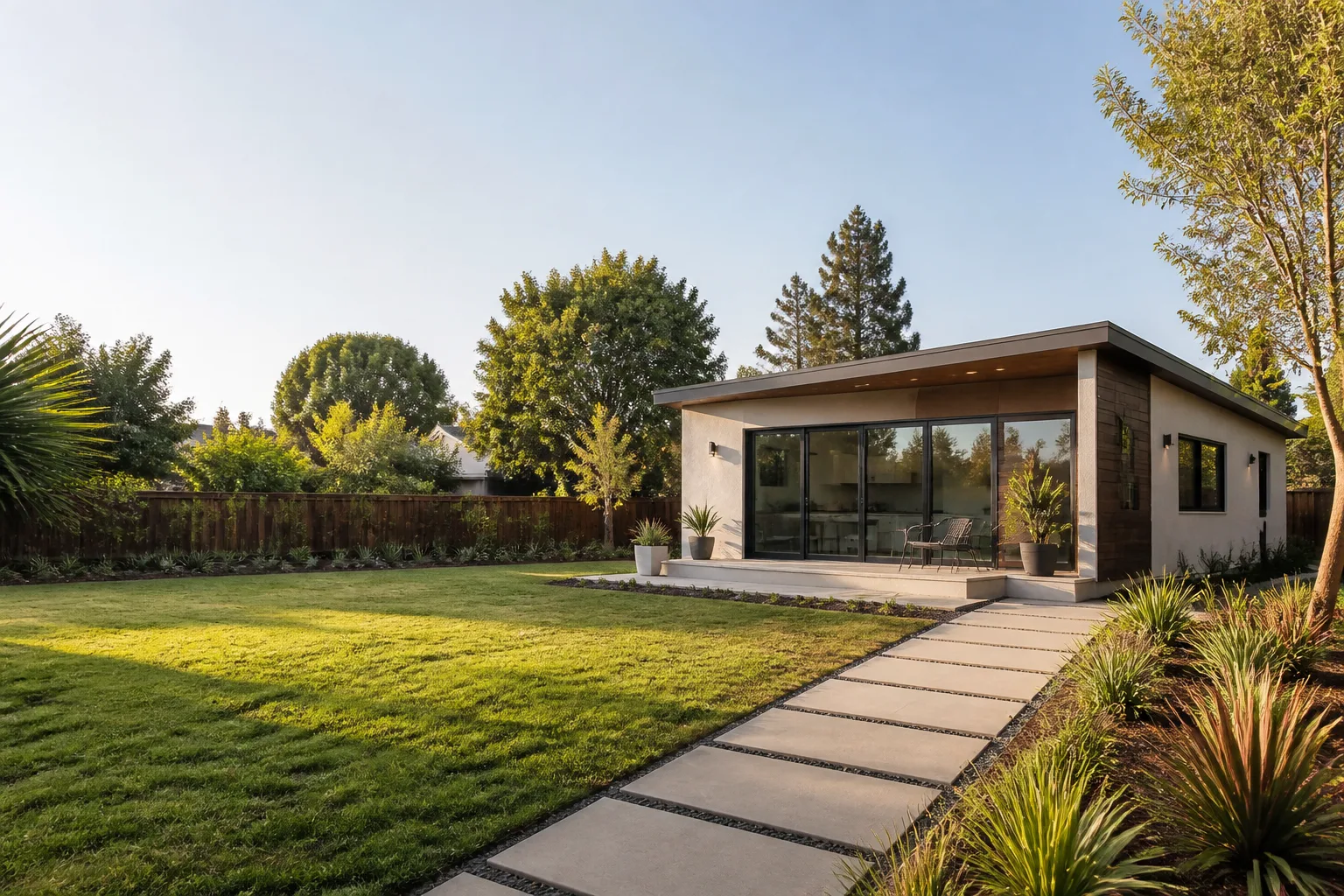
A stick-built ADU on your lot is shaped around your footprint, your setback, and your existing utility runs. It uses materials like James Hardie siding where the appearance matters, and standard framing where it does not. The leading conventional path costs more per square foot than prefab, but it earns it back in the flexibility to match your main house and handle Orange County’s specific code path without compromise.
We have built with Abodu and Cover panels. We have built conventional ADUs with Hardie siding. We can match the method to your lot instead of forcing your lot to match a catalog. The conversation starts there.
If you are comparing Orange County ADU contractors, ask which platform certifications they hold and which specific builds in the county they have done with that platform. A contractor who has never actually delivered a prefab ADU should not be selling you one as his “preferred method.”
Before you settle on a builder, it helps to understand what you are actually shopping for. Start with the ADU Builders in Orange County page for an overview of what a proper build entails. If your scope includes converting the garage instead of building new, read up on Garage Conversion Contractor in Orange County. And if the ADU grows into a larger addition, the Room Addition Contractor in Orange County page covers that path. The more you know before bids come in, the less you will be talked into something you did not ask for.
Common Mistakes to Avoid
- Hiring the first contractor who returns your call. The good ones are booked out. The available-this-week crowd is available for a reason. Wait for the contractor you screened properly.
- Taking the cheapest bid without reading the exclusions. A low bid that excludes trenching, fixtures, or drywall texture is not lower. It is just the same number presented in pieces.
- Signing before the permit path is clear. If no one has looked at the survey, the title, and the city’s setback worksheet, no one has bid the real job. You are signing up for a fight.
- Paying on time but skipping lien waivers. You can pay every invoice and still have a sub file a lien because the contractor pocketed the money. Waivers are the only proof the money went where it was supposed to.
- Believing “insured and bonded” covers you personally. A contractor’s liability policy protects the contractor. It does not automatically fix your roof. Ask for proof and understand what the policy is, and is not, covering.
- Rushing the reference check to “not bother anyone.” The reference is the only evidence you will get that the contractor has finished anything. Bother them.
- Forgetting that Orange County is 34 different rulebooks. What works in Santa Ana does not automatically fly in Laguna Beach or Newport Beach. Coastal zones, historic districts, and hillside overlays change the project. Your contractor needs to know the specific city where you are building.
When to Call a Professional
If any of the following applies to you, stop reading and start calling. You have already reached the point where a professional needs to see the site. You are planning an ADU in a coastal zone, a hillside fire hazard zone, or a historic district. You received a bid that came back with a contingency or cost-plus clause. The contractor you are talking to refuses to provide a written scope, a fixed price, or a lien waiver schedule. You found open permits on a previous project and the contractor will not explain them. Fielding ADU Orange County offers free estimates in Orange County. Call (424) 577-4306 to talk through your lot and your plans before you sign anything.
Frequently Asked Questions
A converted garage ADU in Orange County typically runs $85,000 to $150,000 before permit fees, while a detached new-build ADU starts around $180,000 and often exceeds $300,000 for a two-bedroom with full kitchen. Prefab models from Abodu or Cover usually land between $190,000 and $260,000 delivered, depending on site work. These are working ranges, not bids. Call (424) 577-4306 for an exact quote on your lot.
Permit approval in most Orange County cities runs three to six months for a standard ADU, but coastal zones, historic districts, and fire hazard areas can stretch that past nine months. A contractor who tells you the permit will be done in six weeks is setting you up for an unhappy conversation. Plan for the permit before you plan the build.
No, and in most cases you should not. You want the contractor’s license on file with the city as the responsible builder, not your own name. Owner-builder permits shift the legal responsibility to you, including liability for code compliance and worker safety. Fielding ADU Orange County pulls permits for every job we build, and the permit responsibility is written into the contract.
No legal Orange County contractor will start structural work before the permit is issued. Foundation, framing, electrical, and plumbing all require an issued permit and scheduled inspections. Any contractor who suggests starting early to “save time” is asking you to accept unpermitted structural work, which becomes a legal problem when you sell the house.
Ask for the license number and qualifier name, the last three Orange County addresses where they finaled a permit, a written list of subcontractors, the exact payment and lien waiver schedule, and a fixed price in writing before any work starts. A contractor who answers all of those cleanly is in the top tier. Most will not answer half of them.
Verify the CSLB license is active under the qualifier’s current name, check the city’s permit record for finalized ADU permits at addresses the contractor says they built, and confirm every claim in the contract is in writing. A legitimate Orange County ADU contractor will let you check all of it. Call (424) 577-4306 to walk through our license and permit history directly.
The Bottom Line
The ADU contractor you hire in Orange County will either finish the project or own the story of why not. Screening is the work. License verification, permit history, fixed-price contract, lien waiver schedule, and references who answer hard questions: these are the five things that separate a builder from a deposit-taker. If the contractor will not stand behind every one of them in writing, the bid does not matter. When you are ready to talk, Fielding ADU Orange County will walk your lot, put the price in writing, and build it under The Garrison Standard we have held to since 2006. Call (424) 577-4306 or start with the Fielding ADU Orange County home page.
Written by Reed Calloway, Owner at Fielding ADU Orange County, serving Orange County since 2006.