Last updated October 15, 2026
DIY vs Professional ADU: The Orange County Homeowner’s Decision Guide
Here’s a number most Orange County homeowners never hear until it’s too late: California’s owner-builder disclosure follows your property title for ten years. Not one year, not until the inspection passes. Ten. It goes on every sale document, every refinance application, and every insurance renewal during that window. This guide walks through what that disclosure actually means in today’s Orange County market, where the permit liability really sits, and how to decide whether saving contractor markup is worth carrying a decade of exposure on your own name.
Quick Answer
For most Orange County homeowners, hiring a licensed ADU contractor is the safer financial decision once you factor in permit liability, resale disclosure requirements, and the cost of correcting failed inspections. DIY owner-builder work can save 15 to 25 percent upfront in Orange County, but it transfers all warranty, code-compliance, and construction-defect risk to you, the owner of record, for ten years on the title. The exception is limited-scope work like interior finish or cosmetic upgrades, where the risk exposure is small and the cost savings are real.
Table of Contents
- What California’s Owner-Builder Law Actually Requires in Orange County
- The Real Cost Comparison: DIY Savings vs. Ten-Year Risk Exposure
- Which ADU Work You Can Legally Do Yourself in California (and Which You Cannot)
- The Hidden Costs of Failed Inspections in Orange County
- The Hybrid Model: Owner-Managed General Contract with Licensed Subcontractors
- What a Written Price and One-Year Guarantee Are Worth Over a Ten-Year Hold
- Build Method Choices: Prefab, Modular, and Conventional ADU Construction in Orange County
- Orange County-Specific Factors: Coastal Zones, Fire Zones, and Local Permitting
What California’s Owner-Builder Law Actually Requires in Orange County
California Business and Professions Code Section 7044 allows a homeowner to act as their own general contractor on an ADU project. That’s the law people quote. What’s rarely quoted is what happens after you sign the owner-builder declaration on the permit application. You are certifying, under penalty of perjury, that you will either perform the work yourself or hire licensed subcontractors directly. Then you become the general contractor of record. That means the liability sits on you: construction defects, code violations, workmanship failures, everything.
The disclosure requirement under Civil Code Section 1102 requires you to reveal your owner-builder status on every transfer disclosure statement for ten years from the date the permit was issued. In Orange County’s market, buyers’ agents know to ask about this. Lenders know to ask about this. A buyer who sees “owner-builder” on an ADU disclosure frequently demands a structural inspection by a licensed engineer, or asks for a price reduction to cover that inspection, or walks entirely. We’ve heard from Orange County homeowners in Irvine, Fullerton, and Garden Grove who discovered this at the listing table, not the permit counter.
What this means in practice: the savings you bank upfront by not paying a general contractor gets weighed against the value hit at resale. If you list a home with an owner-built ADU and the buyer’s lender perceives any defect risk, the mortgage can stall. In a competitive Orange County market, that stall can cost you far more than a contractor’s markup.
The Real Cost Comparison: DIY Savings vs. Ten-Year Risk Exposure
The honest numbers for Orange County ADU construction break down like this. A garage conversion typically runs $120,000 to $180,000 when handled by a licensed garage conversion contractor in Orange County. A detached backyard ADU runs $250,000 to $450,000 depending on size, foundation type, and finish level. Acting as an owner-builder, you might save 15 to 25 percent of the general contractor’s portion of the budget, which on a $300,000 build could mean $30,000 to $50,000.
But that savings needs to be measured against real documented risks:
- Correction orders: Orange County inspectors red-tag work that fails code. Each re-inspection carries a fee, usually $150 to $400 depending on the jurisdiction.
- Opening finished walls: If a rough-in inspection fails after drywall is up, you are opening those walls to expose the failed plumbing or electrical work. That’s demolition labor, re-work labor, re-drywall, re-texture, and re-paint.
- Trade call-back rates: When a homeowner acts as their own general, a plumber’s mistake is the homeowner’s problem. You absorb the call-back cost. A licensed general contractor carries that liability on their insurance.
- Lender scrutiny at resale: Owner-built ADUs trigger additional underwriting review on FHA and VA loans, and conventional lenders often require a structural engineer’s certification. That costs money and time.
Over a ten-year hold period, a $30,000 upfront savings that costs you one failed inspection, one open-wall correction, and one resale concession wipes out completely. The math is not complicated when you look at it over the full window.
Which ADU Work You Can Legally Do Yourself in California (and Which You Cannot)
California law draws specific lines around what an owner-builder can and cannot do, even with the owner-builder permit in hand. Understanding these thresholds is the difference between a legitimate project and a code violation waiting to be discovered.
- Plumbing: You can run your own drain lines and supply lines only if you personally occupy the property as your primary residence. Any water heater, gas line, or main line work requires a licensed plumber. No exceptions.
- Electrical: You may perform electrical work as an owner-builder on your own residence, but the work must pass the same inspection as a licensed electrician’s work. In Orange County, many jurisdictions require a final certification by a licensed electrical contractor for the panel and service connections.
- Structural framing: You can legally frame your own ADU as an owner-builder, but the plans must be stamped by a licensed California architect or structural engineer. The stamp is what transfers design liability to a licensed professional. Without it, the city will not even accept the permit application.
- Foundation and concrete: Flatwork is within reach for a careful owner-builder. Post-tension slab foundations, retaining walls over four feet, and any foundation in a seismic zone requiring special detailing must be done by a licensed contractor with the appropriate classification.
- Roofing: Re-roofing your own primary residence is allowed. However, any roof work on a structure requiring a building permit (including an ADU) must typically be performed by a licensed roofer when the roof is part of the permitted scope.
- HVAC: Installing a ducted HVAC system requires an EPA refrigerant certification and a C-20 license. An owner-builder can install a ductless mini-split only if it’s a pre-charged, plug-connected system that does not require refrigerant line fabrication.
Working outside these lines voids your permit, voids any insurance coverage, and creates a resale disclosure problem that gets worse with time, not better.
The Hidden Costs of Failed Inspections in Orange County
In our experience building ADUs across Orange County, the most expensive DIY mistake is not the mistake itself. It’s the discovery timeline. A framing error caught during the rough-in inspection is a fix. A framing error caught after insulation and drywall are installed is a demolition and reconstruction project.
Here’s what a failed inspection sequence actually costs in Orange County when you’re the owner-builder:
- Re-inspection fees: $150 to $400 per visit, per trade, depending on the city. The City of Santa Ana charges one fee; the City of Newport Beach charges another. None are free.
- Correction order compliance: The inspector issues a written correction order. You fix the issue. You call for re-inspection. The re-inspection may reveal a second issue the inspector didn’t catch the first time. This cycle repeats until the work passes.
- Schedule slippage: Every week your ADU sits unpermitted and unfinished is a week you are not collecting rent, which in Orange County runs $1,800 to $2,600 per month for a one-bedroom ADU in most coastal and central markets. That lost rent is a real cost.
- Subcontractor unavailability: When a correction order requires a licensed trade to return and fix what a homeowner-framed wall concealed, that subcontractor may not be available for weeks. The owner-builder waits. The project stalls.
We have corrected owner-builder projects where a single failed plumbing rough-in inspection, hidden behind finished drywall, cost the homeowner $8,000 to $12,000 to open, repair, and close back up. That’s the cost of a mistake that a licensed plumber working under a general contractor’s supervision would have caught before the walls went up. For homeowners looking at a full ADU build in Orange County, this risk alone often justifies professional management.
The Hybrid Model: Owner-Managed General Contract with Licensed Subcontractors
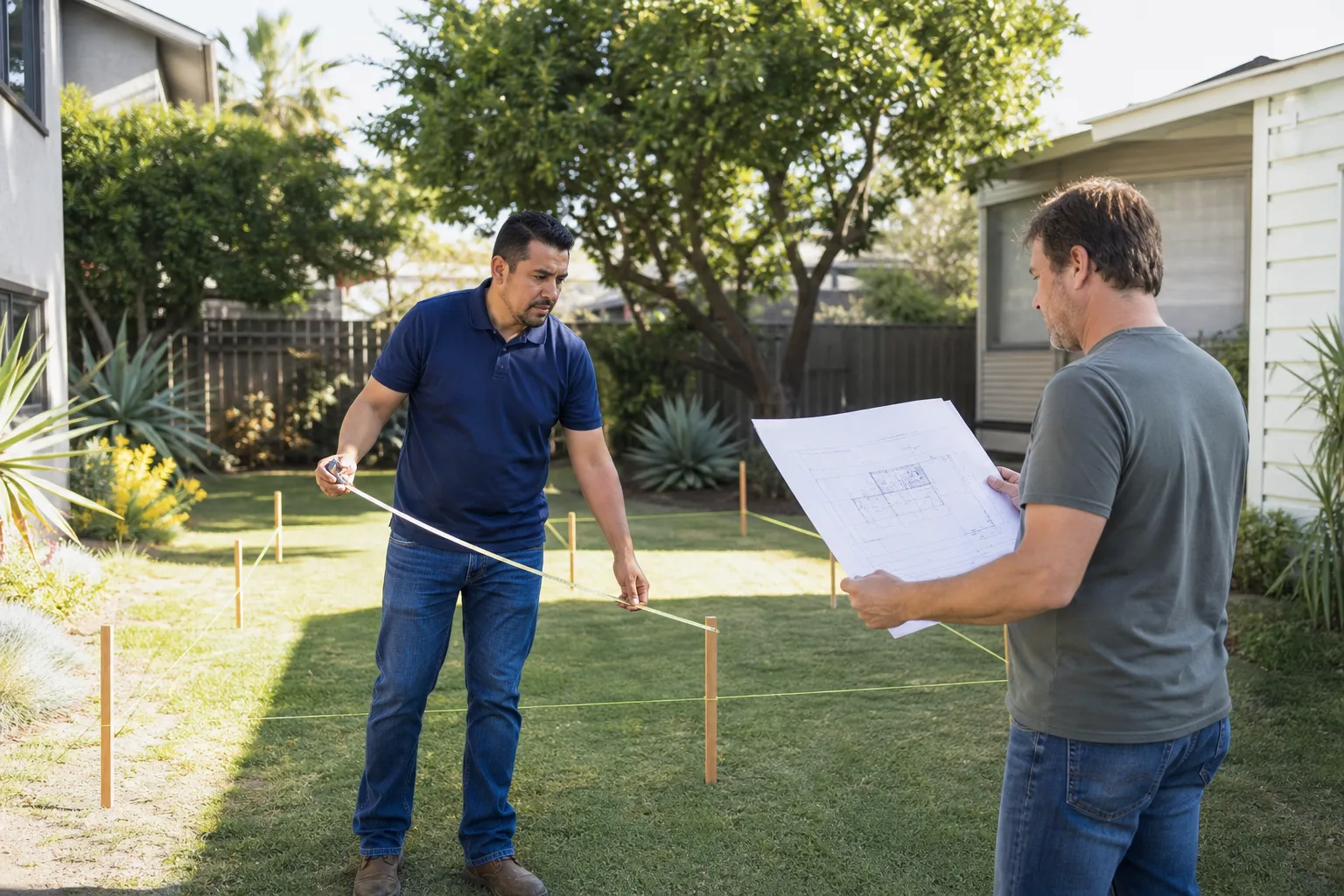
Some Orange County homeowners are drawn to a middle path: serve as your own general contractor, hire licensed subcontractors for each trade, and manage the schedule yourself. This is legal in California and it does save the general contractor’s markup. It also demands skills most homeowners do not have.
What the hybrid model actually requires:
- Plan reading: You must understand architectural drawings well enough to catch framing errors before inspection, not after.
- Sequencing knowledge: You need to know that plumbing rough-in comes before electrical rough-in, which comes before insulation, which comes before drywall. Miss one step and you are opening walls.
- Trade scheduling: You must coordinate a concrete crew, a framer, a plumber, an electrician, an HVAC tech, a drywaller, a taper, a painter, and a finish carpenter. In Orange County’s current labor market, good subcontractors are booked out 6 to 12 weeks.
- Inspection management: You call for inspections, you meet the inspector, you walk the corrections list, and you resolve every item before the next trade can proceed.
- Site presence: You are on site every day trades are working, or you accept the risk of unsupervised work drifting off-plan.
Homeowners who run this model successfully typically have construction experience, a flexible work schedule, or both. For everyone else, the general contractor’s 10 to 15 percent markup is buying something specific: they absorb the coordination, they carry the liability, and they answer the phone when the inspector has a question. A room addition contractor in Orange County does the same job for a scope that requires full permitting and trade coordination.
What a Written Price and One-Year Guarantee Are Worth Over a Ten-Year Hold
Here’s a direct way to measure the value of professional management. A contractor’s written fixed price means the number you approve before the first day of work is the number on the final invoice. An owner-builder carries the opposite risk: every change order, every correction, every failed inspection is a new invoice you write to yourself.
A written one-year guarantee means that if a workmanship defect shows up within 365 days of completion, the contractor returns and corrects it at no charge. Fielding ADU Orange County builds every project to The Garrison Standard, which covers workmanship defects in writing for a full year; for ongoing protection, see our Room Addition Contractor Maintenance Checklist for Orange County Homeowners. If the work fails, we come back and make it right at no charge. That guarantee is specific, it’s on paper, and it’s backed by the same Garrison Partners network that has held to this standard since 2006.
An owner-builder has no such guarantee. Every defect that emerges in year one is yours to fix at market rates. Every defect that emerges in years two through ten on the title disclosure is yours to negotiate at resale. The guarantee is worth whatever a warranty claim costs, and warranty claims on ADU construction are not rare. Plumbing fitting failures, electrical connection issues, stucco cracking, flashing leaks: these happen. Who pays is determined by who held the permit.
At Fielding ADU Orange County, every project receives a written price before any work starts, and every crew member is background-checked and arrives in uniform. You know exactly who is on your site. That’s what the professional model looks like from the inside, and it’s what The Garrison Code requires: show up in the window, price in writing, by the book, leave it clean, stand behind it for a year.
Build Method Choices: Prefab, Modular, and Conventional ADU Construction in Orange County
The build method decision affects the DIY-versus-professional question directly. Prefab and modular ADU platforms like Mighty Buildings, Boxabl, and Plant Prefab ship factory-built modules to the site, where a licensed contractor assembles and finishes them. These systems reduce on-site construction labor, but they do not reduce the permit responsibility. The owner of record still carries the compliance obligation.
What changes with prefab is the supplier dynamic. Mighty Buildings delivers panelized 3D-printed wall systems engineered to California seismic code. Boxabl ships compact foldable units designed for rapid site assembly. Plant Prefab delivers factory-built modules with pre-installed plumbing and electrical. Tuff Shed-style structures offer a lower-cost shell for studios and workspaces. Each platform has specific site preparation requirements, foundation tolerances, and utility connection protocols that vary by city in Orange County.
The conventional route uses stick framing with materials like James Hardie fiber cement siding, which performs well in coastal Orange County’s salt air and resists the moisture issues common in places like Huntington Beach, Costa Mesa, and Seal Beach. Conventional builds allow more design flexibility and easier custom modification, but they require more on-site construction time and more trade coordination.
For the DIY-minded homeowner, the prefab route seems simpler. The modules arrive, a crane sets them, and the finish work begins. But the permit, the foundation, the utility connections, and the inspection process are identical to a conventional build. Prefab does not shortcut the paperwork. And in Orange County, any prefab install still requires a licensed general contractor to oversee the set, the connections, and the final inspection sign-off. The DIY savings on prefab projects are typically smaller than on conventional builds because the factory handles a large portion of the construction, though our Seasonal ADU Care for Orange County: Year-Round Homeowner’s Guide can help protect either build type.
Fielding ADU Orange County works across these platforms, including conventional builds using James Hardie siding, so the build method matches the budget and the lot. We are not tied to one system. You should not be either. For a full breakdown of build methods and pricing, start with our Fielding ADU Orange County home page.
Orange County-Specific Factors: Coastal Zones, Fire Zones, and Local Permitting
Orange County is not one permitting environment. It is 34 separate cities, plus unincorporated county land, each with its own building department, its own plan check timeline, and its own interpretation of state ADU law. What passes easily in one city can stall in the next.
Three factors affect every ADU project in Orange County:
- Coastal zones: Cities like Newport Beach, Laguna Beach, Dana Point, and San Clemente fall under the California Coastal Commission’s jurisdiction. ADU projects in these zones require coastal development permits, which add 6 to 12 weeks to the permitting timeline and come with additional setback, height, and visual-impact restrictions. An owner-builder navigating coastal permit requirements without experienced representation is walking into a process that routinely stalls projects for months.
- Wildland-urban interface fire zones: Inland areas like parts of Orange, Anaheim Hills, Yorba Linda, and Trabuco Canyon sit in high-severity fire hazard zones. ADU construction in these areas must comply with wildfire-resistive building standards: specific siding materials, ember-resistant vents, dual-pane tempered glass in certain exposures, and defensible-space landscape requirements. These codes are intricate and changing. Missing one requirement means a failed inspection.
- Climate-specific construction: Coastal Orange County’s marine layer brings moisture and salt air. Interior areas see summer temperatures above 100 degrees. The right build method for a Laguna Niguel ADU is not the same as the right build method for a Fullerton ADU. Material selection, insulation specification, and ventilation design all shift with the microclimate. A contractor who builds across Orange County sees these patterns. A one-off owner-builder learns them the expensive way.
Every Orange County city also has its own ADU ordinance with specific setback allowances, height limits, and parking requirements. Some cities waive parking entirely for ADUs within a half-mile of transit. Others do not. This is exactly the kind of detail that determines whether your project gets permitted smoothly or stalls at plan check. It is also the kind of detail that most DIY research misses.
Common Mistakes to Avoid
- Signing the owner-builder declaration without reading it: You are accepting full legal responsibility for the project’s code compliance for ten years. Read every sentence before you sign.
- Pulling a permit for work you plan to hire out: If your plumber works under your owner-builder permit, their mistake is your liability. If they work under a general contractor’s permit, the contractor carries the exposure.
- Assuming prefab means no permits: Prefab ADU platforms still require full building permits, foundation permits, and utility connection permits in every Orange County jurisdiction. The factory work is off-site, but the site work is fully regulated.
- Skipping the geotechnical report in hillside areas: Orange County’s hillside communities, including parts of Anaheim Hills, Villa Park, and Santiago Canyon, have expansive and unstable soils. A foundation designed without a soils report is a structural failure waiting to happen.
- Underestimating the schedule: A professional Orange County ADU build takes 12 to 18 months from design to certificate of occupancy. An owner-builder on the same scope typically takes 18 to 30 months. Every extra month is lost rent and carrying costs.
- Treating the one-year guarantee as optional: When comparing bids, ask each contractor what their written guarantee covers and for how long. If the answer is verbal, it is worth nothing. Fielding ADU Orange County puts the full-year guarantee in writing on every project.
- Ignoring resale implications: The ten-year owner-builder disclosure is the single most overlooked cost of the DIY route. Before you save $30,000 on contractor markup, price out what that disclosure will cost you at resale.
When to Call a Professional
Call a licensed ADU contractor when any of these conditions apply: your lot is in a coastal zone, a fire hazard zone, or a hillside area with soil concerns; your project involves structural framing, foundation work, or utility upgrades; you plan to sell or refinance the property within ten years; you do not have a flexible work schedule to manage subcontractors and inspections; or you have been burned before by a contractor who missed the schedule or moved the price. In those situations, the professional route is not an extra cost. It is the cheaper route over the life of the project. Fielding ADU Orange County offers free estimates in Orange County. Call (424) 577-4306 to schedule yours.
Frequently Asked Questions
Yes, California allows homeowners to act as owner-builders on ADU projects, but the designation carries a ten-year disclosure obligation on the property title and transfers all construction-defect liability to you. Certain trades, including gas plumbing, main electrical panel work, and HVAC refrigerant lines, must be performed by licensed contractors regardless of your owner-builder status. Call (424) 577-4306 if you are weighing this route and want a straight answer on your specific scope.
A garage conversion in Orange County typically runs $120,000 to $180,000 before permit fees, while a detached backyard ADU runs $250,000 to $450,000 depending on size, site conditions, and finish level. Prefab and modular ADUs can reduce on-site construction costs but do not eliminate permit fees or site preparation expenses. For a written line-item price on your specific project, call (424) 577-4306 and schedule a free estimate.
The owner-builder disclosure is a California requirement that any home sold or refinanced within ten years of an owner-builder permit must disclose that owner-builder status on the transfer documents. Buyers’ agents and lenders in Orange County use this disclosure to demand additional inspections and may negotiate price reductions to cover perceived risk. The disclosure period runs ten years from the permit issuance date.
Yes, every prefab and modular ADU installed in Orange County requires a building permit, a foundation permit, and utility connection permits identical to a conventional build. The factory-built module reduces on-site labor, but the site work remains fully regulated. Platforms like Mighty Buildings, Boxabl, and Plant Prefab all require licensed contractors to complete the site assembly and final inspection sign-off.
You receive a correction order, pay a re-inspection fee, fix the issue, and schedule another inspection. If the failure is behind finished walls or ceilings, you open those surfaces, repair the work, and rebuild. This process can cost $8,000 to $12,000 or more depending on the scope. A licensed contractor working under a fixed written price absorbs these correction costs as part of their project management. Call (424) 577-4306 to discuss your situation and get a free estimate.
The hybrid model, where you manage the general contract and hire licensed subcontractors directly, works if you have construction experience, a flexible schedule, and the ability to read plans and manage inspections. For most Orange County homeowners, the 15 to 25 percent savings on general contractor markup is offset by schedule delays, coordination errors, and the personal liability you carry for every trade’s work. Before choosing this route, time your own availability honestly for a 12 to 18 month project.
The Bottom Line
The DIY-versus-professional ADU decision in Orange County is not about skill. It is about liability, resale value, and the real cost of your time. California’s owner-builder law lets you save money upfront and hands you a ten-year disclosure obligation in return. For small, low-risk scopes where the savings are meaningful and the exposure is minimal, owner-builder work makes sense. For full ADU construction in Orange County’s coastal zones, fire zones, and hillside communities, a licensed contractor with a written price and a written guarantee is the safer financial decision over the full holding period. The choice comes down to whether you want to carry the risk or pay someone else to carry it for you. Explore more guides & resources to keep your project on track.
Written by Reed Calloway, Owner at Fielding ADU Orange County, serving Orange County since 2006.