James Hardie New Detached ADU: The Orange County Owner’s Guide
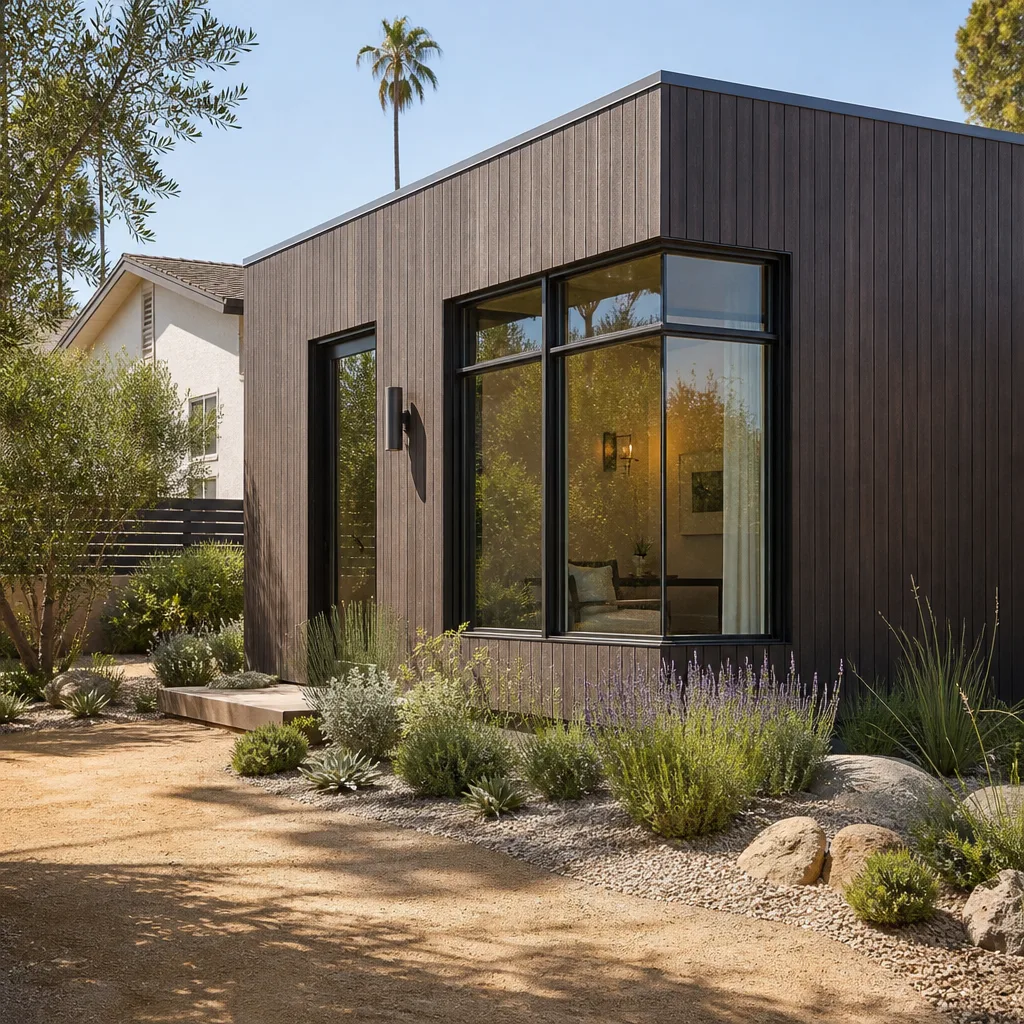
A new detached ADU clad in James Hardie fiber cement is a long-term structure, but the siding, trim, and flashing details are the parts that take the weather first, and in Orange County that weather is sun, Santa Ana wind, and the occasional sideways rain. We stock and install the James Hardie-compatible siding, trim boards, and corner pieces needed to repair or finish a detached ADU, with most repair scopes running $1,800 to $6,400 installed depending on how much of the envelope needs attention. Owners usually find the problem the same way: a cracked corner board after a windstorm, a bottom course of HardiePlank that has swelled from sprinkler overspray, or trim that has pulled loose and let water behind the assembly.
Which James Hardie Models This Applies To
Orange County detached ADUs are typically clad in one of three James Hardie lines: HardiePlank lap siding (the classic horizontal board, 5/16″ thick, available in 4″, 5.25″, 6.25″, and 7.25″ exposures), HardiePanel vertical siding (4′ x 8′, 4′ x 9′, and 4′ x 10′ sheets), or HardieTrim boards (the 5/4″ and 4/4″ trim used at corners, windows, and fascia). The compatibility gotcha most owners hit: you cannot mix a 7.25″ exposure lap with a 5.25″ exposure on the same wall plane without an intentional design break. The board is stamped on the back with the profile and thickness; if the stamp has worn off, measure the visible exposure, not the board width. For replacement parts, we use genuine James Hardie product rather than aftermarket fiber cement. The OEM product carries the 30-year limited substrate warranty, and the color-matched ColorPlus finish, when it applies, is baked on at the factory. Aftermarket boards we have seen fade differently, and the texture does not always line up. Hardie is worth matching exactly.
Signs Your James Hardie New Detached ADU Is Failing
- Bottom course swelling or delaminating: The lowest row of lap siding sits too close to grade, or a sprinkler head is hitting it repeatedly. Fiber cement is dimensionally stable, but constant moisture at the cut edge will make it swell and crumble. Underlying cause: insufficient 6″ clearance from finished grade or an irrigation head aimed wrong.
- Cracked corner trim after wind: HardieTrim at the outside corners takes more flex and impact than any other trim on the structure. A hairline crack at a fastener becomes a split in one Santa Ana season. Underlying cause: fastener too close to the board edge, or no backer at the outside corner.
- Nail heads popped or rusted: You see small circles pushing through the paint or staining below the lap. Underlying cause: the original installer used standard nails instead of the specified hot-dipped galvanized or stainless fastener, or over-drove the nail and broke the board’s face layer.
- Flashing gaps at the roof-to-wall joint: The step flashing where the ADU roof meets the Hardie-clad wall has lifted or was never lapped correctly. Water runs behind the siding in the first real rain. Underlying cause: poor sequencing at the original build, or the flashing was nailed to the wall instead of the roof plane.
- Color fade or chalky surface beyond normal aging: ColorPlus finish on a south-facing Orange County wall will fade over a decade, but an inconsistent or streaky fade suggests the factory finish was over-scrubbed, or the wall gets reflected sun off a neighboring stucco surface. The board itself is still sound; the finish has failed.
Replacement Cost & What’s Included
In Orange County, a James Hardie siding repair on a detached ADU runs in predictable bands. A single-wall trim and corner replacement, with scaffolding if needed, typically lands between $1,800 and $3,200. Re-cladding one full elevation of a 400-500 square foot ADU runs $4,500 to $6,400 including removal, disposal, new flashing at penetrations, and paint-grade or ColorPlus-matched finish. What drives the range: wall height (anything over 10 feet needs pump jacks or scaffold), the number of window and door openings that need re-trimmed and re-flashed, and whether the existing weather-resistive barrier behind the siding is still serviceable. Our written number includes the parts, the labor, the flashing, and the cleanup. If we open the wall and find rotted sheathing, you see it, we explain it, and we give you the revised scope in writing before cutting further. Every Hardie repair we do is covered under the written one-year Garrison Standard guarantee.
DIY or Call Us?
James Hardie siding is not high-tension like a garage spring and it will not electrocute you, but it is heavy, brittle, and unforgiving when cut wrong. A homeowner with a circular saw, a Hardie-specific blade, and a solid ladder can replace a single lap board on a ground-level wall. What goes wrong in DIY: the board cracks during fastening because the nail was over-driven, the cut edge was left unprimed and drank water for a year, or the lap was reset with the wrong exposure and now every course above it is out of horizontal alignment. On any two-story wall, scaffold work, or anything involving flashing at a roof intersection, call a professional. The failure we see most from weekend repairs is a “fixed” bottom course that rots out again in 18 months because the clearance-to-grade issue underneath it was never addressed. If you want a second set of eyes before you open the wall, call us at (424) 577-4306.
FAQs
The HardiePlank and HardiePanel substrate carries a 30-year limited transferable warranty, and in Orange County’s dry climate the boards themselves routinely last 30 to 40 years before substrate failure. The weak points are the trim joints, the flashing details, and any bottom course that sits too close to grade. Expect to re-caulk and touch up paint every 7 to 10 years even when the boards are still fine. Call (424) 577-4306 if you want us to walk the ADU and tell you what is wear-and-tear versus an actual failure.
A hairline crack can be routed, caulked, and painted if it has not opened up or let water behind the board. A split through the fastener hole cannot be reliably repaired and should be replaced. We will make that call honestly when we look at it, and the replacement board cost on a single corner is usually under $200 in parts. Call (424) 577-4306 and we will give you a straight answer and a written price.
A single corner-trim replacement on a one-story ADU is a half-day job once materials are on site. A full elevation re-clad with new flashing runs two to three days. If we have to re-do the weather-resistive barrier behind the siding, add a day. The schedule gets written into the same scope that carries the price, so you know both before we start.
We keep standard HardieTrim boards, corner pieces, and 5.25″ and 6.25″ HardiePlank lap on the truck for typical Orange County ADU models, along with the galvanized fasteners and flashing we use on every Hardie job. Specialty exposures like 7.25″ lap or ColorPlus-matched trim for a specific factory color are ordered for your address and usually arrive within three to five business days. If you are not sure what exposure or profile you have, call (424) 577-4306 and we will talk you through measuring it over the phone.
If your James Hardie-clad detached ADU in Orange County has a failing bottom course, cracked trim, or flashing that let water in, get the scope in writing before anyone starts cutting. We work with Hardie product daily, alongside the prefab and modular platforms we also service, including Abodu, Cover, and Dvele. The Garrison Standard means the price goes in writing before we start, the work is done by the book, and we stand behind it in writing for a full year. Scope in writing. Price in writing. Then we build. Call (424) 577-4306 for a free estimate.
Written by Reed Calloway, Owner, Fielding ADU Orange County at Fielding ADU Orange County, serving Orange County and nearby areas.