Last updated October 15, 2026
The Complete Guide to ADU in Orange County
Most Orange County homeowners who overpay for an ADU didn’t overpay on the build. They overpaid on the first three decisions, before a shovel touched the ground. A bad lot assessment costs you design fees you can’t recover. A bad design costs you bids that don’t compare. A bad financing order costs you months of carrying costs. This guide lays out the full sequence, fourteen decisions in the order they actually matter, so you make each call before a contractor makes it for you. For more guides & resources on ADU planning, see our blog. We’ve built ADUs across Orange County since 2006, and the pattern is the same everywhere from Santa Ana to San Clemente: the homeowners who follow the sequence pay less and finish faster. This is the guide we wish every client read before they called us.
Quick Answer
Building an ADU in Orange County takes 9 to 18 months from first sketch to final inspection, costs $180,000 to $450,000 all-in depending on size and build method, and requires about fourteen distinct decisions made in the right order: lot check before design, design before bids, bids before financing. Get the sequence wrong and you’ll pay $15,000 to $60,000 more than you should, mostly in rework and lost time.
Table of Contents
- The Decision Sequence: Why Order Matters More Than Anything Else
- Orange County Zoning Rules: Setbacks, Overlays, and What Actually Qualifies
- The Four ADU Types in Orange County and Which Parcels Qualify
- What a Written Price Actually Commits a Contractor To
- Real Orange County ADU Costs by Build Method
- Reading a Pro Forma Rental Yield Against Your Real All-In Cost
- Permits and Timeline: What Orange County Cities Actually Require
- Common Mistakes to Avoid
- When to Call a Professional
- Frequently Asked Questions
- The Bottom Line
The Decision Sequence: Why Order Matters More Than Anything Else
Orange County homeowners lose more money to sequencing errors than to bad contractors. The sequence is lot check, then design, then bids, then financing. Reverse any two steps and the cost compounds.
Here’s the sequence as we lay it out for every client in Orange County:
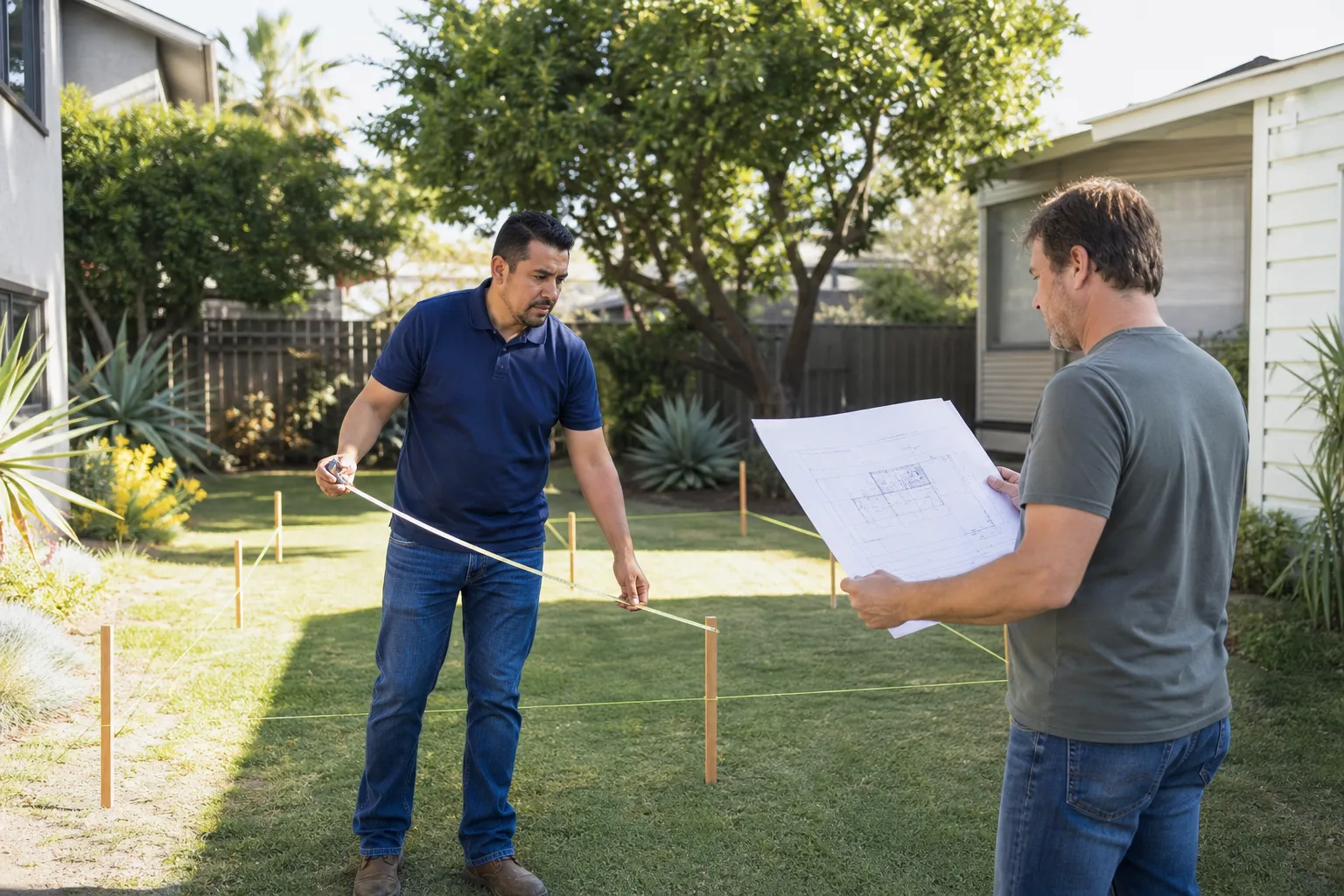
- Lot check and zoning first. Before you draw a single wall, confirm your parcel’s setback requirements, lot coverage limits, and any overlay restrictions with your city’s planning department. In Orange County, cities like Irvine, Huntington Beach, and Fullerton each apply their own overlays on top of state ADU law. A parcel in one city may allow an 800-square-foot detached ADU; the identical parcel three miles away may cap you at 500 square feet because of a hillside or coastal overlay.
- Design second, based on what the lot actually allows. Design follows zoning, not the other way around. If you design a 750-square-foot unit and then discover your setback variance (the city’s written permission to build closer to the property line than the standard rule allows) is denied, you’ve spent $8,000 to $15,000 on plans you can’t use.
- Contractor bids third, against a complete, approved design. Bids only compare when they’re for the same scope. If you get three bids on a rough sketch, you’re comparing three different guesses, not three prices. We’ve seen Orange County homeowners accept a low bid on a vague design and then watch the final invoice climb 20 to 40 percent through change orders.
- Financing last, against a written price. Lenders want a number, and the only number that matters is the written price from your contractor after a complete design. Take out a loan before you have that number and you’re financing a guess.
Reversing steps one and two costs plan rework. Reversing three and four costs financing gaps. In our experience building ADUs in Orange County since 2006, the homeowners who follow this order close out their projects closest to their original budget.
Orange County Zoning Rules: Setbacks, Overlays, and What Actually Qualifies
California state ADU law sets a baseline, but Orange County cities layer their own rules on top. The state says a detached ADU can be up to 1,200 square feet regardless of lot size. But your city may say otherwise through local ordinances and overlays.
Key rules that affect Orange County parcels specifically:
- Setbacks. State law caps side and rear setbacks for detached ADUs at 4 feet. But Orange County cities can impose stricter setbacks in hillside zones, coastal zones, or fire hazard severity zones. Homes in Anaheim Hills or Yorba Linda with steep slopes often face additional setback requirements from the local fire authority.
- Owner occupancy after AB 2221. Before 2022, some Orange County cities required the property owner to live on site if they built an ADU. AB 2221 removed most owner-occupancy requirements for ADUs permitted between 2020 and 2025, and the state is likely to extend that timeline. This matters if you plan to build an ADU on a rental property you don’t live in. Confirm your city’s current position before you assume you’re clear.
- Coastal zone overlays. Newport Beach, Laguna Beach, Huntington Beach, and Seal Beach sit inside the California Coastal Commission’s jurisdiction. ADUs in these cities face additional review for coastal access, view preservation, and environmental impact. Add 2 to 4 months to your timeline if your parcel falls inside the coastal zone.
- Fire hazard severity zones. Large portions of Orange County’s eastern edge, including parts of Orange, Silverado Canyon, and Trabuco Canyon, sit in Cal Fire’s high severity zones. ADUs there require fire-resistant siding, screened vents, and often a 100-foot defensible space zone. James Hardie fiber cement siding is one of the materials we specify frequently in these areas because it meets the fire code without sacrificing design flexibility.
- Lot coverage limits. Most Orange County cities cap total lot coverage, the percentage of your parcel covered by structures, at 40 to 50 percent. A 6,000-square-foot lot with a 2,000-square-foot house and a 400-square-foot garage has room for an 800-square-foot ADU before hitting a 50 percent cap. Run the math before you design.
We start every Orange County ADU project with a zoning check at the city level, not the county level. The city is where the restrictions live.
The Four ADU Types in Orange County and Which Parcels Qualify
Orange County homeowners have four legal ADU types to choose from. Each fits different parcel conditions, and choosing the wrong type for your lot is one of the costliest mistakes we see. Here’s what qualifies for each:
1. Detached ADU (Backyard Unit)
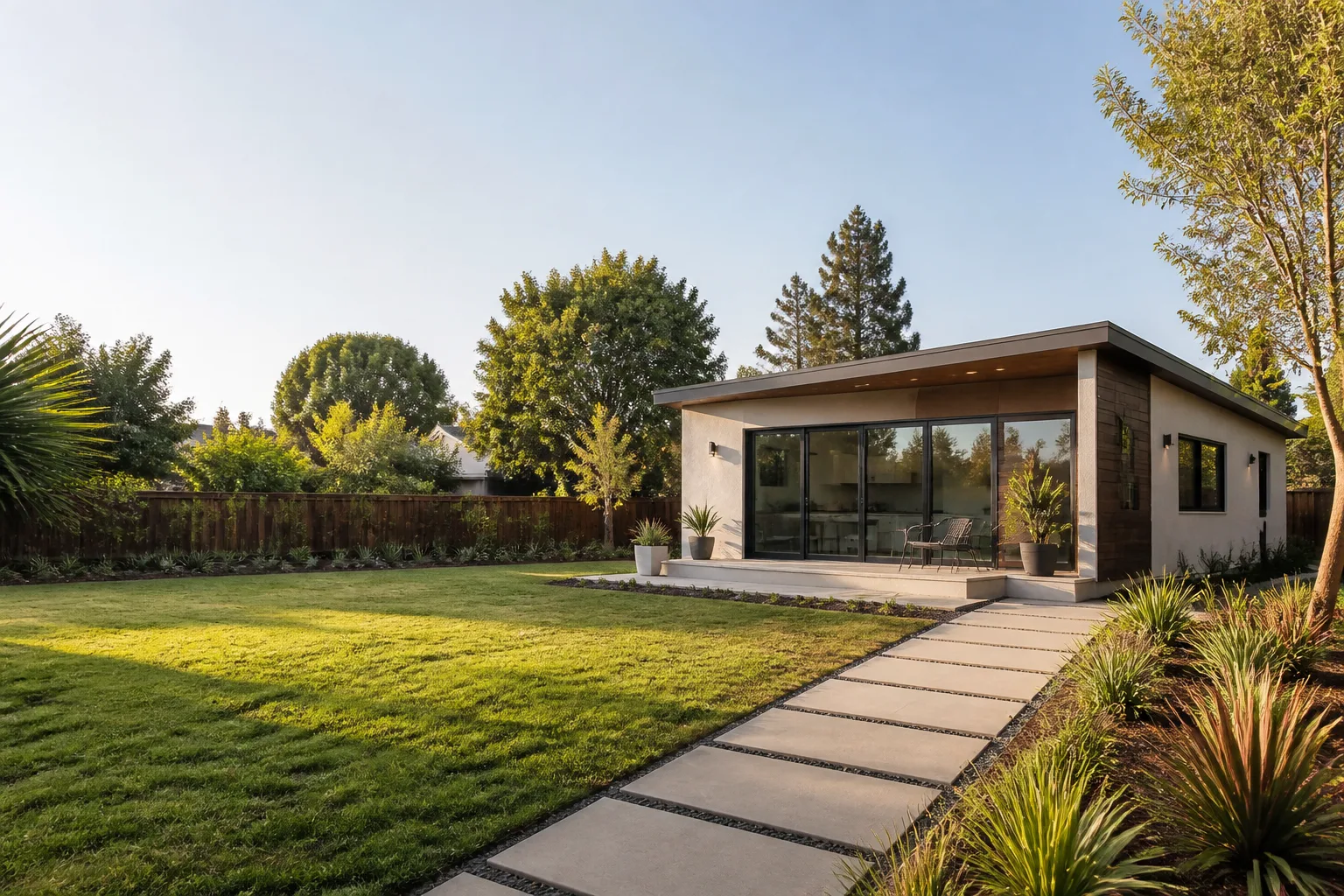
A standalone structure in your backyard, typically 400 to 1,200 square feet. State law guarantees your right to build one up to 1,000 square feet if your lot meets basic requirements. Detached ADUs work best on parcels with usable backyard space and setback clearance of at least 4 feet from all property lines. They’re the most expensive type per square foot because they require full foundation, framing, roofing, and utility runs. But they’re also the most flexible for rental income because tenants get complete privacy.
On Orange County lots larger than 6,000 square feet, detached ADUs are usually the highest-value option. On smaller lots, they compete with your existing backyard space and may trigger lot coverage fights at city hall.
2. Attached ADU (Addition to Existing Home)
An ADU built as an extension of your primary house, sharing at least one wall. Attached units are capped at 50 percent of the primary dwelling’s square footage or 1,000 square feet, whichever is less. They cost 15 to 25 percent less per square foot than detached units because they share foundation and utility connections with the main house.
Attached ADUs make sense when your lot lacks backyard space for a standalone unit, or when you want to keep the ADU integrated with the main house for multigenerational living. We’ve built attached ADUs in older Orange County neighborhoods like Old Towne Orange and downtown Fullerton where lots are narrow and backyards are small.
3. Garage Conversion ADU
Converting an existing attached or detached garage into a living unit. This is the fastest and least expensive ADU type because the structure already exists. In Orange County, garage conversions typically run $120,000 to $200,000 before permit fees, depending on whether the garage needs structural reinforcement, new foundation work, or utility trenching.
Garage conversions work best when your garage is in decent structural shape and you’re willing to lose covered parking. One caveat: if your garage was attached and you convert it fully, you’ll need to replace any required parking spaces. Most Orange County cities waive replacement parking for ADUs within half a mile of transit, but not all do. Check with your city. Our Garage Conversion Contractor in Orange County page covers the specifics of what garage conversions require locally.
4. Junior ADU (JADU)
A JADU is a small unit, up to 500 square feet, built inside the existing walls of your primary home, typically a converted bedroom, den, or attached garage section. JADUs are the cheapest option because they need no new foundation, no new utility connections, and minimal structural work. They’re also the only ADU type that still allows a city to require owner occupancy in some cases.
JADUs work best for homeowners who want rental income without losing backyard space or parking. They’re popular in Orange County neighborhoods with smaller lots and in cities where detached ADUs face stiff lot coverage limits.
If you’re still deciding which type fits your parcel, our ADU Builders in Orange County page walks through the decision in more detail.
What a Written Price Actually Commits a Contractor To
There’s a legal difference between an estimate and a written price, and Orange County homeowners who don’t know the difference get burned. An estimate is a contractor’s guess, often given verbally or on a one-page sheet with no scope detail. It commits the contractor to nothing. A written price, in the form of a fixed-price contract with a detailed scope of work, commits the contractor to complete the specified work for the specified number.
Here’s what a legitimate written price includes:
- A full scope of work. Every trade, every material, every finish level is listed. If it’s not in the scope, it’s not in the price, and it will become a change order later.
- A fixed price number. The total you’ll pay if the scope doesn’t change. Not a range. Not a “starting at” figure. One number.
- Allowances, if any. Some items, like appliances or tile, are listed as allowances with a specified dollar amount. Know what the allowance covers and what happens if you go over.
- Change order terms. The contract spells out how changes are priced and approved. Written change orders signed by both parties protect you from mid-project price shifts.
- Permit and inspection terms. Who pulls the permits, who schedules inspections, and what happens if an inspection fails.
- Payment schedule. Dollar amounts tied to completed milestones, not to calendar dates. If a contractor asks for a large upfront deposit before any work is done, that’s a red flag in California. State law caps the down payment for home improvement projects at 10 percent of the contract price or $1,000, whichever is less.
- Warranty terms. A written warranty spelling out what’s covered, for how long, and how claims are handled.
At Fielding ADU Orange County, every project follows The Garrison Code: show up in the window, price in writing, by the book, leave it clean, stand behind it for a year. The price goes in writing before any work starts, and the number you approve is the number on the final invoice. The Garrison Standard covers workmanship defects for 365 days; if something fails, we come back and make it right at no charge. That’s not a marketing phrase, it’s the contract language.
Real Orange County ADU Costs by Build Method
Orange County ADU costs vary by build method, square footage, site conditions, and finish level. Here are real ranges we see in the market in 2026, before permit fees, which add another $8,000 to $25,000 depending on your city:
- Garage conversion ADU (400 sq ft): $120,000 to $190,000
- Attached ADU (500 sq ft): $160,000 to $240,000
- Detached ADU, conventional build (600 sq ft): $210,000 to $320,000
- Detached ADU, premium prefab (600 sq ft): $240,000 to $380,000
- Detached ADU, conventional build (1,000 sq ft): $310,000 to $450,000
- Detached ADU, premium prefab (1,000 sq ft): $350,000 to $500,000
- JADU (300 sq ft): $80,000 to $140,000
These numbers shift with site conditions. A sloped lot in Yorba Linda adds foundation costs. A parcel in a fire hazard severity zone adds siding and venting costs. A coastal zone project in Huntington Beach adds review time and, often, design revisions.
Build method also changes the math. Prefab manufacturers like Abodu and Plant Prefab ship units built in a factory, which eliminates weather delays and reduces on-site labor by 30 to 50 percent. But prefab units require crane access, which not every Orange County lot can accommodate. Conventional builds give you more design flexibility but run longer on site. We’re fluent in both methods, including Tuff Shed-style structures for budget-conscious builds, so we can match the method to your lot and budget rather than forcing one approach on every project. See our DIY vs Professional ADU: The Orange County Homeowner’s Decision Guide to weigh your options.
Reading a Pro Forma Rental Yield Against Your Real All-In Cost
Contractors love to hand you a pro forma rental yield sheet. It shows a 600-square-foot ADU renting for $2,800 a month and pays for itself in 7 years. The math is usually correct. It’s also usually incomplete.
A legitimate pro forma includes all of these:
- All-in construction cost. Build price, permit fees, design fees, engineering fees, school fees, and utility connection fees. In Orange County, non-construction costs typically add 15 to 20 percent to the build price.
- Financing cost. Interest on the construction loan or HELOC, including any interest-only period during construction.
- Vacancy rate. Orange County rental vacancy runs 2 to 4 percent. Model at least one month of vacancy per year.
- Property management cost. If you use a manager, 8 to 10 percent of gross rent. If you self-manage, value your time at something.
- Maintenance and repairs. Budget 5 to 8 percent of annual rent.
- Insurance increase. Adding an ADU raises your homeowners premium. Budget $500 to $1,500 more per year.
- Property tax increase. Your assessed value goes up, which raises your annual property tax bill. In Orange County, this typically adds $2,000 to $6,000 per year depending on the ADU’s value and your tax rate.
Run those numbers against the real all-in cost and you’ll see the true yield, which is frequently 2 to 4 percentage points lower than the contractor’s pro forma shows. That’s still a good investment for many Orange County homeowners. But you should make the decision on real numbers, not a sales pitch.
We tell clients to ask any contractor one question: does your pro forma include property tax, insurance, and vacancy? If the answer is no, treat the pro forma as a starting point, not a decision document.
Permits and Timeline: What Orange County Cities Actually Require
Permitting is where Orange County ADU projects stall. State law requires cities to review and approve or deny a complete ADU permit application within 60 days. But that clock doesn’t start until your application is complete, and cities define complete differently.
A typical Orange County ADU permit package includes:
- Site plan showing property lines, setbacks, existing structures, and the proposed ADU location
- Architectural drawings with floor plans, elevations, and sections
- Structural engineering calculations and drawings
- Title 24 energy compliance documentation
- Electrical, plumbing, and mechanical plans
- Grading and drainage plans if your lot has slope or drainage issues
- Fire sprinkler or fire code documentation if required by your city or fire authority
Most Orange County cities take 3 to 6 months from application to permit issuance for a standard detached ADU. Coastal zone projects in Newport Beach, Laguna Beach, or Huntington Beach can take 6 to 12 months because of Coastal Commission review. Fire zone projects add another 1 to 2 months for fire authority review.
After permitting, construction runs 4 to 9 months for conventional builds and 2 to 5 months for prefab builds, depending on site conditions and utility connection timelines. Southern California Edison and Orange County’s local water districts are often the bottleneck. Getting a new electrical service connection or sewer lateral approval can add 2 to 3 months that no contractor can control.
A realistic total timeline for a detached ADU in Orange County is 12 to 18 months from first design meeting to final inspection. Plan for that. If someone promises to finish in 6 months, ask which steps they’re skipping.
Common Mistakes to Avoid
- Designing before checking zoning. You pay $8,000 to $15,000 for plans, then discover your setbacks or lot coverage kill the design. We see this every month in Orange County. Zoning check first, always.
- Taking bids on a rough sketch. Three contractors bidding on a vague concept are bidding on three different projects. You cannot compare the numbers, and the low bid is usually the one that scoped the least.
- Assuming state law overrides your city. State ADU law sets a floor, but Orange County cities add their own restrictions on top. Check your city’s specific ordinances, not just the state rules.
- Signing an estimate instead of a written price. An estimate commits the contractor to nothing. A written price with a detailed scope commits them to a number. Know the difference before you sign.
- Ignoring property tax and insurance in your yield model. Your ADU will raise your property tax bill and your insurance premium. Leave those out of your pro forma and you’ll overestimate your return by thousands of dollars a year.
- Skipping the school fee estimate. Some Orange County school districts levy impact fees on ADUs over 500 square feet. These can run $3,000 to $8,000. Ask your city about school district fees before you commit.
- Choosing the wrong ADU type for the lot. A detached ADU on a 5,000-square-foot lot in Fullerton may blow your lot coverage. A garage conversion might be the better call. Match the type to the parcel, not to the brochure.
When to Call a Professional
You don’t need a contractor to do a zoning check or read a pro forma. But you do need one to verify site conditions, price the project accurately, and pull permits correctly. Call a professional when you’re ready to move from research to build. Specifically: when you have a lot you’re serious about and want a real site assessment; when you’ve confirmed your city’s rules and want to know which ADU type fits your parcel; when you have a design and want a written price against it; when you’re comparing build methods and need straight answers on prefab versus conventional. Fielding ADU Orange County offers free estimates in Orange County – call (424) 577-4306. We’ll walk your lot, check your zoning, and hand you a written price before any work starts. No pressure, no pricing games, just the real number.
Frequently Asked Questions
An ADU in Orange County costs $80,000 to $500,000 all-in depending on type, size, build method, and site conditions. A 300-square-foot JADU runs $80,000 to $140,000. A 600-square-foot detached ADU runs $210,000 to $320,000 for a conventional build. A 1,000-square-foot detached ADU runs $310,000 to $500,000. Permit fees, design fees, and utility connection fees add 15 to 20 percent on top of the build price. Call (424) 577-4306 for an exact quote on your specific lot – estimates are free.
Plan on 12 to 18 months from first design meeting to final inspection for a detached ADU in Orange County. Permitting takes 3 to 6 months for standard projects, longer in coastal zones. Construction runs 4 to 9 months for conventional builds and 2 to 5 months for prefab. Utility connections from Southern California Edison and local water districts can add 2 to 3 months that no contractor controls.
Under AB 2221, most owner-occupancy requirements for ADUs in Orange County are suspended through at least 2025, and the state is expected to extend that timeline. Junior ADUs are the exception; some cities can still require owner occupancy for JADUs. Check your specific city’s current ordinance before you assume you’re exempt.
An estimate is a contractor’s guess and commits them to nothing. A written price is a fixed-dollar amount tied to a detailed scope of work in a signed contract. In California, the written price is what the contractor is legally obligated to deliver for that number, unless you agree to a change order. Always get the written price before work starts.
Yes, but your options narrow. Small lots with less than 5,000 square feet often cannot fit a detached ADU because of lot coverage caps and setback requirements. Garage conversions and JADUs are usually the practical options on small lots. A zoning check will tell you what your specific lot can actually accommodate. Call (424) 577-4306 and we’ll check your parcel’s limits.
Yes. Every ADU in Orange County requires a building permit, and most require additional permits for electrical, plumbing, and mechanical work. Building without permits creates problems when you sell the property or file an insurance claim, and unpermitted work can trigger fines from your city. We pull every permit and pass every inspection as standard practice.
The Bottom Line
Building an ADU in Orange County is a sequence of fourteen decisions, and the homeowners who make them in the right order pay less and finish faster. Lot check before design. Design before bids. Bids before financing. Know your city’s rules, not just the state baseline. Know the four ADU types and match one to your parcel, not your preference. Demand a written price with a real scope of work, not an estimate. Run your rental yield against all-in costs, including tax and insurance. Then call a builder who puts the price in writing and stands behind the work. That’s how you build an ADU in Orange County without overpaying for the first three decisions.
Written by Reed Calloway, Owner at Fielding ADU Orange County, serving Orange County since 2006.